Menú Cerrar

About FICIMAD

 
FICIMAD (Festival Internacional de Cine Independiente de Madrid) is an annual international competition in Madrid (Spain) which accepts films from all over the globe, offering awards in various categories. The festival, founded in 2021, is held every year in spring.
 
The festival’s biggest prize is the Don Quixote Award, which awards the Best Picture of the edition. Other important awards are Mambrino’s Golden Helmet for Best Director, the FICIMAD Grand Jury Award and the FICIMAD Grand Audience Award.
 
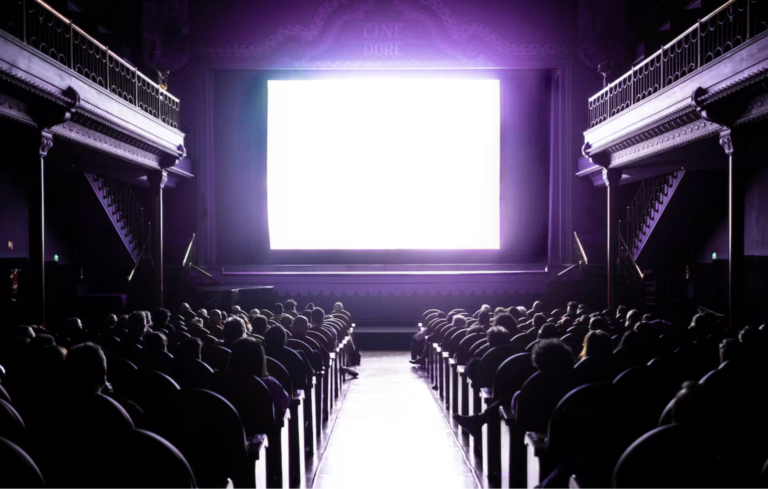
FICIMAD always holds screenings of the films selected for the occasion in one of the best cinemas in the city of Madrid, filling the theaters with passionate spectators. Every year, Madrid becomes the capital of independent cinema and auteur cinema where hundreds of fans of the seventh art and representatives of the film sector come together to indulge their love for cinema in all its aspects.
 
We dedicate ourselves to awarding films based on their originality and creativity, whilst considering their budget restrictions. The films are chosen and selected without having any prejudice or undervaluation regarding the person or place from which they come. We serve any type of film genre, appreciating the particularities and indifferences of the films without having any prior preference. We strongly consider work that challenges traditional and current visual communication methods while continuing to function as a mode for exploring narrative and personal expression.
 
The winning films will be in live screening in an event for all audiences. Our mission and goal is to discover and promote talented filmmakers from all over the world and present them to the public and promotes the discussion and study of filmmaking.
 
The FICIMAD gala has professional presenters, initial live audiovisual show, constant film screenings for an entire day, presentation of trophies to the main awards and free Spanish gastronomic food catering. Admission to the event is free to guarantee that there is a massive audience, creating every year an enjoyable, fun, enriching, memorable and artistic show.


FICIMAD Cinemas


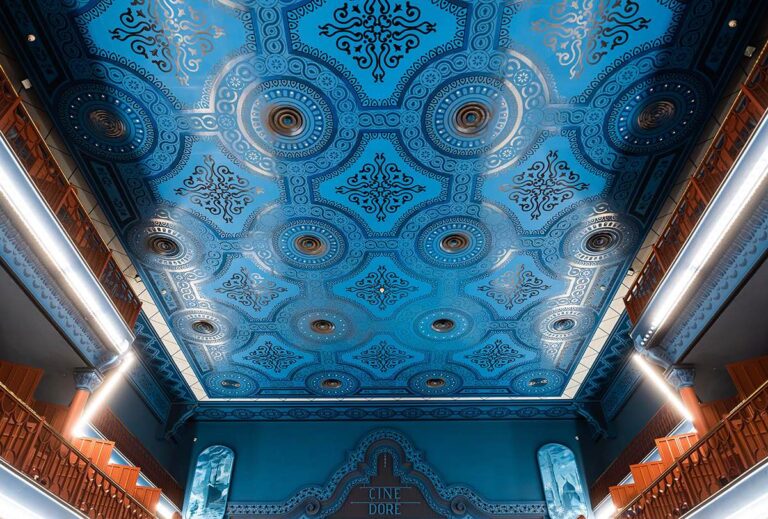
FILMOTECA ESPAÑOLA (CINE DORÉ)
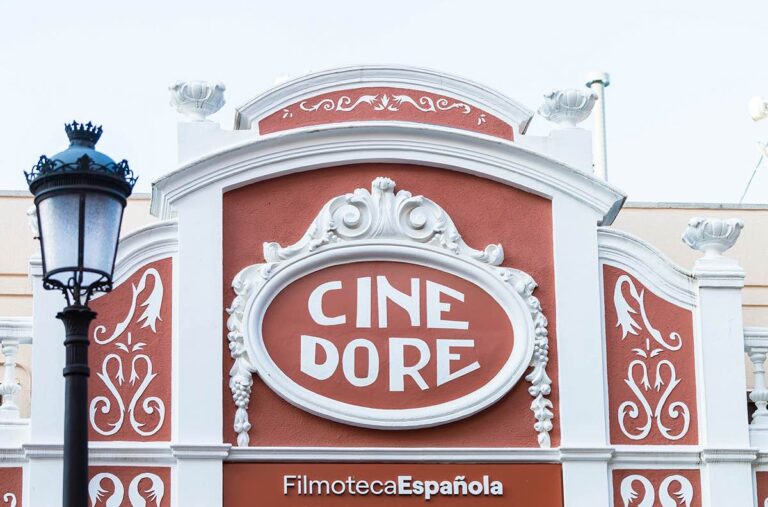
The first cinema in Madrid was installed in 1896 by a Lumière concessionaire in the basement of the now-defunct Hotel de Rusia, on Carrera de San Jerónimo. At the beginning of the 20th century, films were shown in “salons,” mobile booths, theaters, or performance halls. As film footage increased, permanent booths were built on vacant lots. Their structure remained primarily wooden, but gradually, masonry walls, plaster sets, and decorations to attract audiences were added.
 
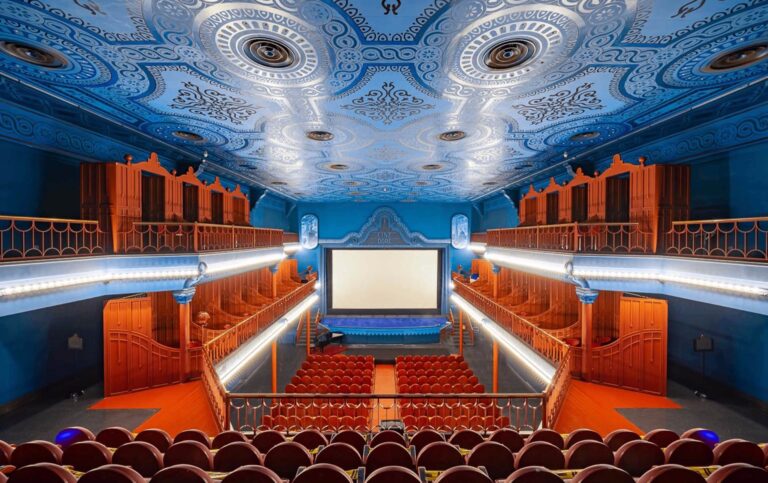
The Cine Doré is one of Madrid’s cinema venues, and began as a venue for various social leisure activities: what was then called “a salon.”
 
The Salón Doré opened on December 19, 1912, at its current location at 3 Calle Santa Isabel, in the Antón Martín neighborhood. It had a capacity for 1,250 spectators and consisted of a ground floor and two upper floors, a garden, and a smoking room.
 
However, the current Cine Doré was built in 1923. The project dated back to 1922, and the plans were signed by architect Críspulo Moro Cabeza, under the direction of industrialist Arturo Carballo Alemany. Master furniture maker Francisco Garriga also participated in the construction of the Doré. The construction license was issued on October 17, 1922. The modernist style adopted for the Doré was common in early-20th-century cinemas and was consistent with the architecture then being developed in Madrid.
 
In the years immediately following its opening, the Cine Doré must have been quite famous and business was prosperous. This is evidenced by the work carried out inside. In December 1924, the then tenant (Aurelio Ruiz) commissioned architect Manuel López-Mora to redesign the box seats on the top floor and on the sides. The Cine Doré screened with great success: “Gloria que mata” (January 1925), by Rafael Salvador, a documentary about the death of bullfighter Manuel Granero; and “Frivolinas” (April 1927), directed by Arturo Carballo, a film entrepreneur himself, consisting of several revue issues without a plot structure, and whose restoration was recently carried out by the Spanish Film Archive.
 
However, few premieres—at least national ones—were held in the theater. The screenings included musical performances by an orchestra and choirs. Among the main performers were well-known artists of those years, such as María Caballé, Rosita Rodrigo, Eva Stachino, “Ramper,” and Miguel Ligero.
 
The existence of the Cine Doré was affected by the gradual decline of the Antón Martín neighborhood, which lost its main functions and was reduced to a collection of services: markets, cinemas, etc.
 
Beginning in the 1930s, the Cine Doré was set up as a rerun theater, with two daily screenings. Until its closure in 1963, it was a neighborhood cinema, popularly known as the “Palace of Pipes.”
 
Until 1982, when the Municipal Corporation—protected by the Madrid Urban Planning Plan—acquired the Cine Doré as a building of architectural and environmental interest that should be preserved, it remained abandoned to its fate, especially the façade and exterior walls.
 
Following its purchase by the City Council and the signing of the agreement to transfer it to the Ministry of Culture, it was decided to use it as a permanent screening venue for the Spanish Film Archive, and its restoration, financed by this department, began by architect Javier Feduchi. The architectural and decorative elements of the old building were preserved, and a second cinema was built on the lower level. The central hall was restored and converted into a café and bookstore, preserving its characteristic rectangular courtyard with a balcony, illuminated by a central skylight. Several offices were installed on the first floor. The first restoration project for the Doré dates back to May 1982. Work continued until 1989, with the cinema inaugurated on February 28 of the same year.
 
This provided, for the first time, the Spanish Film Library with its own space for public screenings and restored one of Madrid’s oldest and most distinctive cinemas, within the so-called Atocha-Antón Martín axis, with the prospect of consolidating itself as a renewed cultural center for the city.


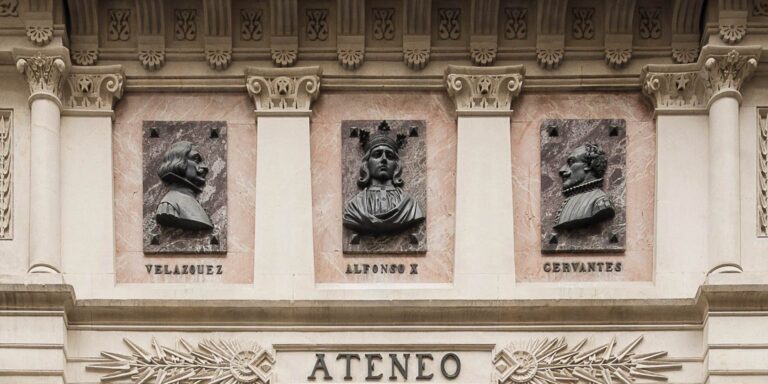
ATENEO DE MADRID 

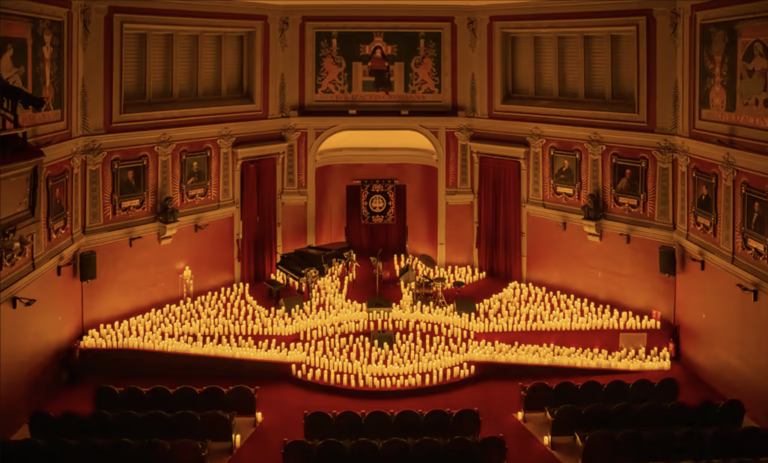
The Ateneo de Madrid (“Athenæum of Madrid”) is a private cultural institution located in the capital of Spain that was founded in 1835. Its full name is Ateneo Científico, Literario y Artístico de Madrid (“Scientific, Literary and Artistic Athenæum of Madrid”).
 
The political, social and cultural turbulence that took place between 1808 and 1814 when the Napoleonic invasion took place was accompanied by a political change – the Constitution of Cadiz of 1812 – through which the absolute monarchy was replaced by a constitutional monarchy, through which the people were guaranteed a regime of liberties that turned the subject into a citizen. Fernando VII, on his return from his confinement in Valençay (France), annulled all these political conquests, reestablishing the absolute monarchy. For this reason, when the constitutional regime was imposed again in 1820, in the so-called liberal triennium, enlightened minds thought of the need to strengthen a liberal mentality in the country through debate, open discussion and the expansion of “the lights”. That was the function assigned to the Spanish Athenaeum, founded in that same year, as an initiative of Juan Manuel de los Ríos, at the request of the Sociedad Económica Matritense; the Athenaeum thus emerged as a “patriotic society” defending freedom of thought and its expression through free discussion. When in 1823, with the absolute monarchy restored again, these liberals, forced to leave the country, went to London, they founded a Spanish Athenaeum in that capital, taking advantage of the new experience to infuse it with the breath of the then-current romanticism. With this baggage they returned to Spain in 1833.
 
In 1835, under the protection of the liberal winds imposed by the then Regent, Maria Cristina of Naples, the Scientific and Literary Athenaeum was founded, to which the epithet of Artistic was later added; the founders were Ángel de Saavedra (Duque de Rivas), Salustiano Olózaga, Mesonero Romanos, Alcalá Galiano, Juan Miguel de los Ríos, Francisco Fabra and Francisco López Olavarrieta, imbued with the purest romantic-liberal spirit. Free discussion was imposed in the gatherings, which would give open and unrestricted debate the leading role in an intellectual activity that took shape in the so-called “Cacharrería”. The courses, the sections, the cycles of conferences, would complete the framework of a feverish and passionate cultural life.
 
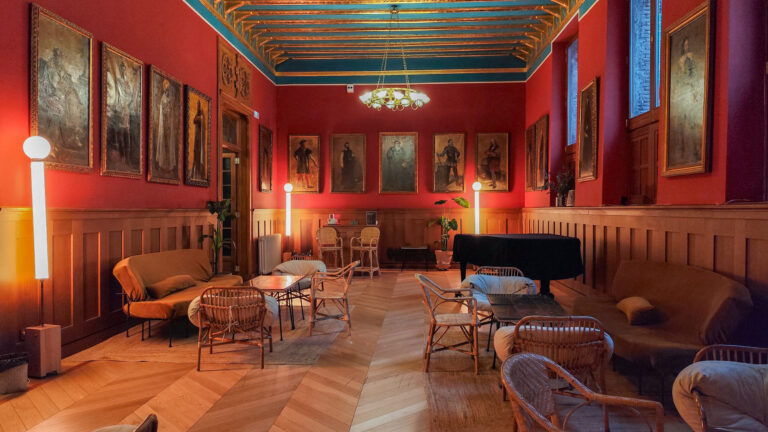
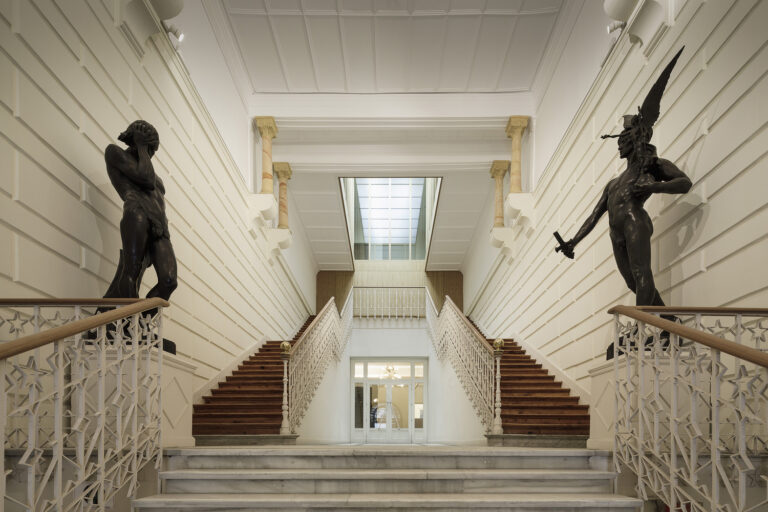
The Ateneo has been in various locations: the Abrantes Palace, Carretas Street, Plaza del Ángel and Montera Street, until its current location at Calle del Prado 21. The modernist building, which now houses its headquarters, is the work of architects Enrique Fort and Luis Landecho. Arturo Mélida gave it artistic content with valuable neo-Greek style paintings in the Assembly Hall and the English Hall; recently restored, these spaces are an indisputable jewel. Antonio Cánovas del Castillo inaugurated this House in 1884, with a famous speech attended by the King and Queen of Spain. Very eminent men have occupied the Presidencies of the Ateneo: Laureano Figuerola, Segismundo Moret, Gumersindo de Azcárate, A. Alcalá Galiano, A. Cánovas del Castillo, M. de Unamuno, Fernando de los Ríos, Manuel Azaña, etc., having acted as catalysts for very important political and cultural activity. Six Prime Ministers, all of our Nobel Prize winners, political leaders of the Second Republic and the most renowned members of the Generation of ’98, ’14 and ’27 have passed through the Ateneo. And although the dictatorships of Primo de Rivera and General Franco during the 20th century seriously affected its activity, today it remains an essential cultural reference point.


SALA EQUIS

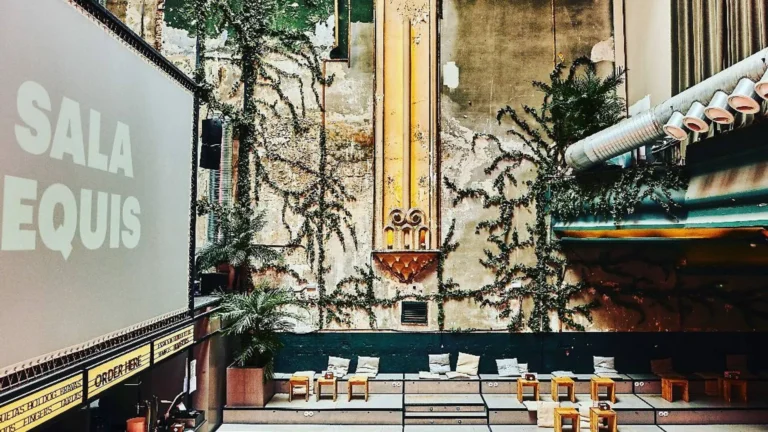
Located in a historic building in the city center, where Madrid’s last porn movie theater, the Alba cinema, once stood, this large entertainment space embraces film culture. All of this is accompanied by a street-style gastronomic offering that fosters social gatherings.
 
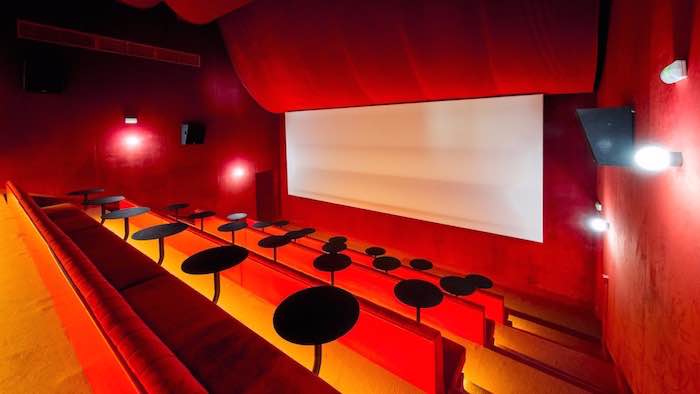
Sala Equis is divided into four areas: the Terrace, at the entrance, a wide alley-like corridor that welcomes visitors; the Ambigú, one of the first meeting and discussion areas among low tables; the Plaza, the former stalls of the Alba cinema, has been transformed into Sala Equis’ cultural plaza, a place where shared experiences mingle around an informal gastronomic offering designed for sharing. Acoustic concerts, custom-made stage sets, and chance encounters shape the spirit of this shared space. and the Cinema Room, dedicated exclusively to avant-garde underground cinema, regularly programmed in its original version with subtitles and also hosting visits from actors, directors, and screenwriters to participate in meetings and special screenings.
 
Among the activities held in this space, in addition to screenings (films, concerts, music videos, film and musical galas), you can enjoy theater, stage performances tailored to the space, and acoustic concerts.


CINE PAZ

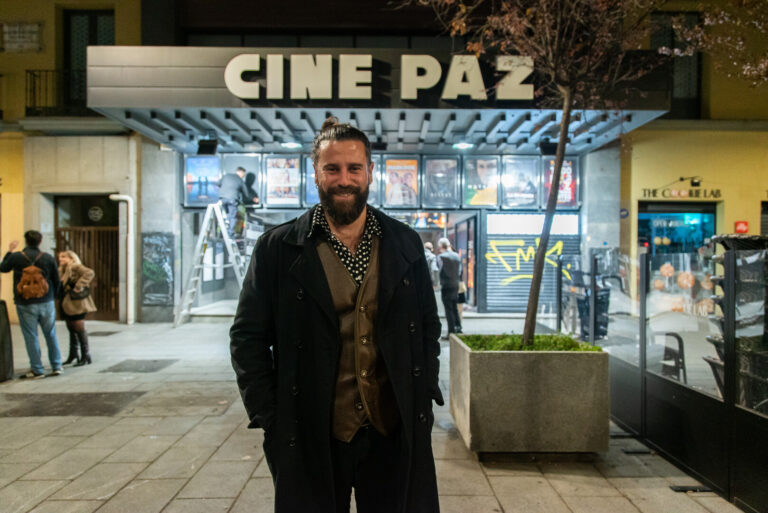
The Cine Paz of Madrid is much more than a movie theater: it is a symbol of the city’s cultural and cinematic memory. Located on Calle Fuencarral, in the heart of Madrid, it opened its doors in 1943 and has since stood as a privileged witness to the evolution of cinema and of Spanish society itself. Born in the aftermath of the Spanish Civil War, Cine Paz offered generations of Madrileños a space for escape, gathering, and shared emotion.

Over the decades, it has adapted to technological changes and shifts within the film industry, evolving from a single large auditorium into a multi-screen cinema, while preserving its essence and commitment to audiences. At a time when many historic theaters disappeared under the pressure of large commercial multiplexes and digital platforms, Cine Paz endured as one of the oldest operating cinemas in Spain. That continuity has granted it an incalculable heritage value.
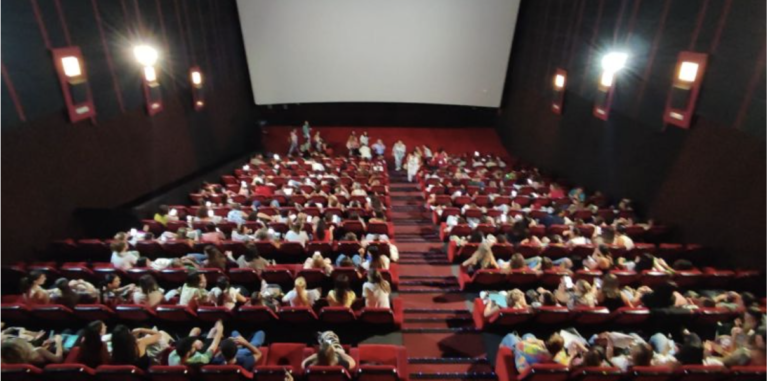
Cine Paz has not merely screened films; it has created memories. Its seats have welcomed highly anticipated premieres, family Sunday matinees, auteur film cycles, and cinematic discoveries that shaped viewers of all ages. It has been a meeting point for devoted cinephiles and for those simply seeking the magic of the big screen.

Its importance lies in this dual identity: an emblematic physical space and a collective emotional refuge. In an increasingly digital and individualized world, Cine Paz represents the shared experience—the complicit darkness of the auditorium and the expectant silence before the film begins. Ultimately, it is a living piece of Madrid’s cultural heritage and a lasting tribute to the power of cinema as both art and communal experience.